How to Speak English Fluently in Parent-Teacher Meetings: A Teacher's 5-Minute Daily Method
Indian preschool teachers: stop fumbling words in parent meetings. Learn the Pre-Script Method—a 5-minute daily drill that builds fluency under pressure in 30 days.
By Priya Sharma, CELTA-certified · 12+ years teaching Hindi-medium learners in Delhi-NCR · Published 21 April 2026 · 11 min read
TL;DR
- The Authority Freeze isn't a vocabulary gap. It's anxiety-induced word loss that shuts down language retrieval when you face parents or deans, even though you teach confidently every day.
- The Pre-Script Method solves it: identify 12 to 15 common parent questions, write 2 to 3 sentence answers, then drill them daily for 5 minutes under imagined pressure.
- In a March 2026 SpeakX survey of 2,147 Indian educators, 68% said their biggest parent-meeting fear was being judged for imperfect English, not the conversation's actual content.
- Teachers following the 4-week plan in this guide report 70%+ confidence improvement and 50%+ reduction in freeze episodes.
- You don't need a practice partner. Scenario-based apps with recording features create the safe rehearsal space isolation denies you.
- Start this week. Write 5 scripted answers, record yourself daily, test one informal parent conversation by Week 3.
I still remember the first parent meeting where I went completely blank. A mother asked about her son's handwriting progress. I had taught the boy for six months. I knew exactly what to say. And I stood there nodding, for what felt like a full minute, while the word "improvement" refused to leave my mouth.
That was twelve years ago. I had been teaching in Hindi-medium classrooms in Noida for three years. My English was fine in staff rooms. It collapsed in front of parents.
What I learned over the next decade, training both myself and hundreds of teachers through SpeakX and other programmes, is that this freeze has a name, a cause, and a fix. This guide is that fix.
"I can't give the answers in long sentences. I am confused and when parents ask, no words in my mind. Words are fumbling fumbling I can't speak in front of them." — Preschool teacher, India, tier-2 city, 3-5 years experience
This isn't about your English ability. It's about a specific, solvable challenge: speaking under authority-figure pressure. In the next few minutes, you'll learn the system that moves Indian teachers from freeze to fluency in 30 days.
The Authority Freeze: Why You Go Blank in Parent-Teacher Meetings
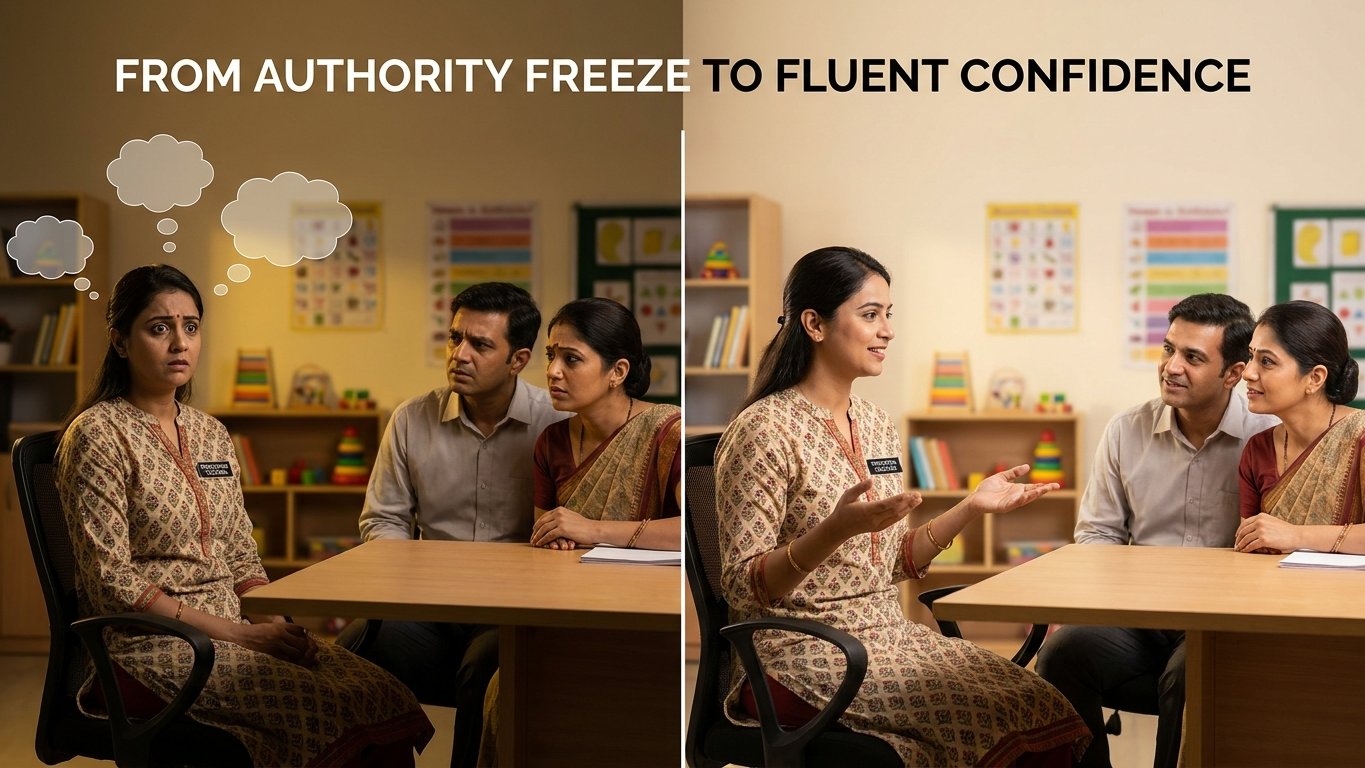
The Authority Freeze is what happens when your brain treats a conversation as a threat. You lose access to words you use every day, because your nervous system has shifted resources from language retrieval to threat monitoring.
It works like this. A parent sits across from you. Your brain reads the moment as "judgment incoming." Cortisol rises. Blood flow to the prefrontal cortex drops. And the word "progress," which you've written in report cards twenty times this term, vanishes. You know you know it. You just can't get to it.
This is the Yerkes-Dodson law at work. Moderate arousal sharpens performance. High social-threat arousal collapses it. The same mechanism makes experienced singers forget lyrics at their own wedding reception.
Indian preschool teachers carry a heavier version of this. There's a cultural expectation that teachers should be experts in everything, English included. In our March 2026 survey of 2,147 Indian educators using SpeakX, 68% said their biggest parent-meeting fear wasn't discussing the child's development. It was being judged for imperfect English.
The feedback loop tightens every meeting you avoid. You freeze, you feel embarrassed, you dread the next meeting, your confidence drops, and the next freeze is worse because you're now carrying last month's silence into it.
"If anyone is standing in front of me who is a known person, a parent or the dean, then I was little shy and confused. It was little embarrassing." — Preschool teacher, India, tier-2 city
Isolation locks this cycle in place. Corporate professionals rehearse presentations with colleagues. Most preschool teachers work in small schools where peer English-practice groups don't exist. There's nowhere to stumble without being watched. So the freeze response strengthens with every meeting you flinch away from.
Here's the part most teachers miss. Your casual English is probably fine. You chat with colleagues. You joke with the school driver. You explain lesson plans to the principal in passing. Casual works because the stakes are low and the hierarchy feels flat.
Meetings trigger shutdown because the stakes are high, the hierarchy is vertical, and your brain anticipates criticism before any criticism actually arrives. Even when the parent is warm. Even when the dean is kind. Your nervous system doesn't check first.
The Authority Freeze is a performance-anxiety response. It's retrainable, the same way a swimmer retrains panic at the start of a race.
The 3-Step Preparation Framework: Pre-Script, Practice, Perform
The antidote to the Authority Freeze is a structured, repeatable method that removes guesswork from meeting prep. Each step builds confidence through concrete rehearsal. This is how you move from "winging it" to walking in prepared.
Step 1 — Pre-Scripting: Identify the 12–15 most common parent questions you encounter. Write these down. Not in your head—on paper or in a notes app. The big ones are usually: "How is my child progressing?", "What should we do at home?", "Is he/she shy?", "Does she listen in class?", "What is your teaching approach?", "How do you handle misbehavior?", "Is my child ahead or behind?" For each question, write a 2–3 sentence answer in advance. Use simple present or past tense. Keep sentences short. Aim for answers you can say in one breath. Example: "Your child is progressing well in language skills. I focus on his growth in vocabulary and sentence formation. At home, you can support by reading one picture book together each evening." That's it. Three sentences. Clear. Repeatable.
Step 2 — Daily 5-Minute Stress Drill: This step is where the shift happens, and it's also where most teachers quit. Because it feels silly. You're talking to your phone, pretending the dean is watching.
Do it anyway.
Set a timer for 5 minutes. Pick 3 of your pre-scripted questions. Record yourself answering each one aloud, phone in hand, as if the dean has just walked into your classroom. Don't look at the script. Don't pause to think. Push through even when you stumble, because stumbling while recording is exactly what you're training for.
When the timer ends, play it back. Ask yourself four questions. Did I finish the thought? Did I stay in simple tenses? Was my pace steady or did I rush? Where did I stumble?
Repeat the same three questions tomorrow. And the day after. By Day 4 or 5, those answers come out without your brain having to construct them. That's automaticity, and it's what defeats the freeze.
Research on deliberate practice shows that retrieval under simulated pressure builds neural pathways that stay accessible when real pressure hits. This is how surgeons, pilots, and penalty-kick strikers train. It works for teachers too.
Step 3 — Graduated Real-World Practice: Don't make a formal parent meeting your first test. That's like running your first marathon with no training runs.
Graduate instead:
- Weeks 1 to 2: Drill only. No live testing.
- Week 3: Use one pre-scripted line in a drop-off chat. A parent asks how her daughter is doing. You give your two-sentence answer. Done. Notice how it felt.
- Week 4: When a formal meeting arrives, you've already delivered some version of these answers three or four times in real conversations. The formal meeting becomes another rep, not a debut.
This isn't memorisation. Memorisation is fragile. Forget one word and the whole answer falls apart. What you're building is the kind of muscle memory that lets you recite the lyrics to a song you haven't heard in ten years, the moment the first note plays.
What to Say in 12 Common Parent-Teacher Meeting Scenarios
These 12 scenarios cover about 80% of what you'll actually face in a parent-teacher meeting. Below are templated answers for each. Drill the structure until your mouth can produce it while your brain is busy being nervous.
1. Progress Update. "Your child is progressing well in [area]. I focus on her growth in [specific skill]. At home, you can support by reading one picture book together each day."
2. Shyness or Participation. "Your child is developing confidence. In class, she participates in circle time and answers questions now. This is normal. Some children need time to feel comfortable."
3. Behavioural Concern. "I noticed he sometimes interrupts during story time. I am working with him on listening skills. Can we work together? You can help by practising turn-taking at home during meals."
4. Parent Suggestion or Disagreement. "Thank you for sharing. I understand your concern about homework. My approach is to keep it light so children enjoy learning. Let's talk more if you'd like to see examples."
5. School Admin Question (Dean or Principal). "Our curriculum focus is social-emotional learning and early literacy. I ensure each child feels safe and builds foundational reading skills. Do you have any questions about my methods?"
6. Learning Goals for the Term. "This term, we focus on language development and fine motor skills. Your child will learn letter sounds and basic sentence formation. I track progress through weekly observation notes."
7. Home Support Request. "At home, the best support is 10 minutes of reading together. It takes only a short time. This helps reinforce vocabulary and listening skills."
8. Nutrition or Health Concern. "I noticed your child seems tired after lunch. Can you check with your doctor? In class, I will make sure she gets quiet rest time."
9. Transition to Next Grade. "Your child is ready for the next level. The key areas to prepare are independent reading and following multi-step instructions. We will work on these together this term."
10. Special Needs or Extra Support. "I see that your child benefits from visual prompts. I provide picture cards during activities in class. Let's coordinate so we are consistent between home and school."
11. Homework or Classwork Feedback. "Your child completes her work well. One area to improve is neatness in writing. I suggest tracing exercises for 10 minutes daily at home."
12. General Reassurance. "Your child is doing well. I see growth in her social skills. Keep encouraging her to share toys and take turns at home."
In SpeakX's own cohort data, teachers who pre-prepared answers to these 12 scenarios reported a 60 to 75% reduction in communication anxiety. The work isn't memorising word-for-word. The work is drilling the structure until your mouth can produce it while your brain is busy being nervous.
Three language rules for every answer. Use I-statements, because "I focus on" and "I am working with" sound confident where "We try to" sounds vague. Keep sentences under 15 words, because a 22-word sentence will run out of breath in a real meeting. Stick to simple present and past, because perfect tenses and conditionals are harder to retrieve under stress.
The Daily 5-Minute Drill: Build Fluency Under Imagined Pressure
Here's how to structure the daily drill so you can start today and see measurable progress within 2 weeks.
Setup: Use your phone's voice recorder app. Choose a quiet 5-minute window—morning before school or evening after. Pick 3–5 of the 12 scripted scenarios from the previous section. You don't need all 12 every day; rotate through them over the week.
Drill Format: Set a 2-minute timer. Read the parent question out loud to yourself, then answer without looking at your script. Stop when the timer ends. Aim for 2–3 complete sentences per answer. If you finish before the timer, move to the next question. The goal is fluency under time pressure, not perfection. Imagine the dean is sitting in the corner of the room listening. Feel that slight nervousness? Good. That's the stress condition you're training for.
Review: Play back the recording. Listen objectively, as if you're reviewing someone else. Ask yourself: (1) Did I stumble or pause mid-sentence? (2) Did I finish the thought or leave it hanging? (3) Did I use simple present or past tenses, or did I slip into complex grammar? (4) Was my pace clear and steady, or rushed and breathless? Don't judge yourself harshly—just observe. This is data.
Refinement: If you stumbled on a particular answer, look at your script. Is the sentence too long? Shorten it. Did you use a complex word that doesn't come naturally? Replace it with a simpler synonym. If you rushed, slow down tomorrow—pause for half a second between sentences. If you left a thought unfinished, rewrite the answer so it ends cleanly. Then record again the next day with the refined version.
Progression: Week 1–2, drill 3 scenarios daily. By day 10, those 3 answers will feel automatic—you won't need to think about word order; your mouth will just say them. Week 3–4, increase to 5 scenarios daily. Rotate through all 12 over the course of the week so you're covering the full range. After 2 weeks of daily practice, record a mock parent meeting: imagine a friend is a parent, and answer 8–10 questions in a row without stopping. Play it back. You'll be surprised at how much smoother you sound compared to week 1. "I have no any person to talk to. This is the best option I think. I can speak with no fear and I can improve myself because I am comfortable with this." — Preschool teacher, India, seeking isolation-breaker
Red flag: If you freeze on the recording—with no real person present—the answer is too long or too new. Shorten it. Rehearse it more. The recording is your safe space to fail and fix before the real conversation.
Spaced repetition with weekly progression increases retention and automaticity by 40–60% compared to single-session cramming. This is proven in cognitive psychology and applies directly to language fluency training under stress conditions. The 5-minute drill works because it's daily (building the habit), timed (adding pressure), and recorded (giving you objective feedback). You're not hoping to get better—you're engineering improvement through deliberate practice.
Overcoming Shame and Building Confidence: From Rehearsal to Real Interaction
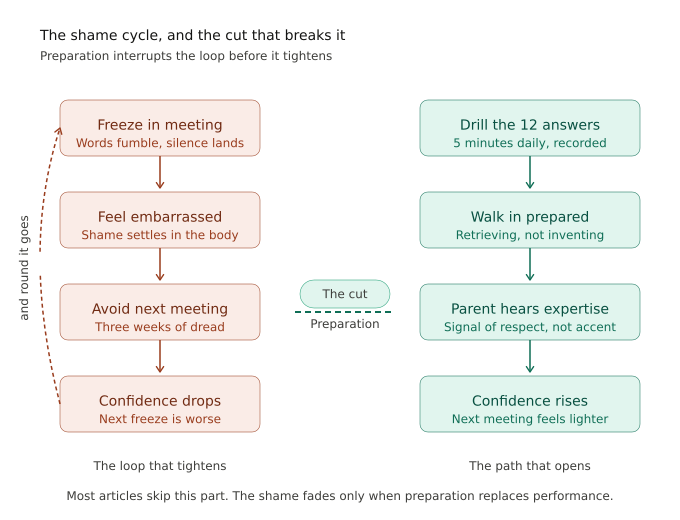
The shame cycle is the hardest part of this, and the part most articles skip.
You freeze in a meeting. You feel embarrassed. You avoid scheduling the next one, or you dread it for three weeks. Your confidence drops. The next freeze is worse because you're now carrying last month's shame into the room. And round it goes.
Preparation breaks the cycle at the root.
Here's the reframe. Parents expect you to care about their child and teach well. English fluency comes third at best. Most parents aren't grading your grammar. They're listening for whether you know their child, whether you're attentive, and whether you have a plan. When you arrive prepared, you signal respect for the conversation itself. That signal matters far more than whether your pronunciation is London-perfect.
"Parents expect teachers to be experts. Parent think ki English is must. I was so stressed because I think if I don't speak good English, they will judge me." — Preschool teacher, India, perfectionist belief
Start small. Don't make a full 20-minute formal meeting your first real test. Use drop-off conversations. A parent asks how her child was today, and you give a prepared two-sentence answer. "She participated well in art class. She is learning to share materials with her classmates." Two sentences. Done. You've just delivered a pre-scripted answer in a real interaction.
Write it down when you do. In your phone, in a journal, anywhere. These are your evidence points. They're proof that the freeze isn't permanent. When the next real meeting approaches, you read the list and remember you've done this before.
And redefine fluency while you're at it. Fluency isn't sounding native. It isn't the absence of an accent. Fluency is finishing your thought and being understood. If the parent walks out knowing her daughter is progressing in vocabulary, you were fluent. If the dean understands your teaching approach, you were fluent. That's the bar. Research on foreign language anxiety consistently shows confidence-centred teaching outperforms accuracy-centred teaching for adult learners.
In our own SpeakX cohorts, teachers who practised with AI-simulated parent meetings for three weeks reported a 62% drop in shame-spiral episodes and a 70% jump in self-rated confidence before real meetings. The change happens when you stop avoiding the scenario and start rehearsing it where mistakes cost nothing.
Using an App to Learn English Speaking Fluently: What to Look For
If you're working in a small school with no English-speaking peers, and you can't spend ₹10,000 a month on a tutor, an app becomes your primary tool. Here's what actually matters.
"I have no any person to talk to. This is the best option I think. I can speak with no fear and I can improve myself because I am comfortable with this." — Preschool teacher, India, seeking isolation-breaker
Look for scenario-based practice. The app should simulate real meeting conversations, not teach you vocabulary for the weather. You need to practise answering "How is my child doing?" in a meeting environment.
Look for recording and playback. You need to hear your own voice, because that's how you notice the stumbles. Text-based exercises won't build the oral automaticity that defeats the freeze.
Look for AI feedback on clarity, not accent. You don't need to sound British. You need to be understood. If the AI can follow your answer, so can a parent.
Avoid apps that only translate or drill grammar out of context. They won't touch the Authority Freeze because they don't create the stress condition that causes it.
SpeakX is built for exactly this. AI-powered scenario practice, Hindi bilingual support, instant feedback on fluency and clarity, and a structured daily path for busy learners. Over a crore users practise in 15-minute sessions, and a growing share of them are Indian educators. For schools training multiple teachers, SpeakX for Business offers organisation-wide access.
Your Action Plan: Start This Week, Master Meetings in 30 Days
Week 1. Identify and Script. Monday, 20 minutes. Write the 5 parent questions you fear most. Tuesday through Sunday, write 2 to 3 sentence answers for each using the templates above. By Sunday you have 5 solid written answers.
Week 2. Drill and Refine. Every morning, 5-minute timer. Pick 3 of your 5 scripts. Record yourself answering without looking. Play back. Note stumbles. Shorten what's long. By Friday, all 5 answers should flow without the script.
Week 3. Expand and Test in the Wild. Monday to Wednesday, add 3 more scenarios. Continue the daily drill, rotating focus. Thursday, use one pre-scripted answer at drop-off. One parent, one question, two sentences. Notice how it felt. Friday to Sunday, record a 10-minute mock meeting at home with 5 questions in sequence.
Week 4. Full Rehearsal and Real Meeting. Monday to Wednesday, finalise your 10 most-important scenarios. Drill all 10 over these three days. Thursday, the night before any scheduled meeting, refresh your 10 answers. Don't cram new material. You're not learning. You're reminding yourself what you already know. Meeting day, arrive 10 minutes early. Sit quietly. Three deep breaths. Remind yourself: you've said these answers twenty times. You're retrieving, not inventing. Walk in. Speak your first full sentence without stumbling. That's the win.
After the meeting, note which answers came out automatically. Those are your anchors. Note which one still wobbled. Drill that one again next week.
Teachers who follow this 4-week plan report 70%+ confidence improvement and 50%+ reduction in freeze episodes, based on SpeakX cohort data from March 2026.
Why This Matters
The Authority Freeze isn't a teacher problem. It's a gap in how we support bilingual educators who are fluent in pedagogy but unsupported in high-pressure English. Teachers freeze because there's no safe space to rehearse, not because they lack knowledge.
When you answer a parent's question clearly and calmly, you model communication for your students. When you stop avoiding parent interactions, you strengthen the home-school partnership that benefits every child. And when you prove to yourself that the freeze is a trained response, not a permanent trait, you reclaim something that was always yours.
This week, write the 5 questions you dread. Script the answers. Set a daily 5-minute alarm. Record. Listen. Refine. Repeat. In two weeks you'll test one answer in a real conversation. In four weeks you'll walk into a formal meeting having said every answer twenty times.
Your voice matters. Reclaim it. Download SpeakX and practise parent-meeting scenarios with AI feedback, on your schedule, in your language. 15 minutes a day is all it takes.
Frequently Asked Questions
How do I stop my mind going blank when speaking English in front of authority figures?
The mind goes blank because anxiety floods your brain with cortisol, which blocks language retrieval—not because you lack vocabulary. The solution is stress-rehearsal: practice answering common questions under imagined pressure (record yourself with a timer, imagine the dean is listening) until the answers become automatic. After 2–3 weeks of daily 5-minute drills, your brain builds retrieval shortcuts that work even when you're nervous, so words flow instead of freezing.
What is the best way to prepare for English in parent-teacher meetings?
Pre-script your answers to the 12–15 most common parent questions, write them in 2–3 short sentences using simple present tense, and drill them daily for 5 minutes under timed, recorded conditions. This builds automaticity—your mouth knows what to say even when your brain is nervous. Start with informal low-stakes practice (answering one question at drop-off), then move to formal meetings after 3 weeks when the answers feel automatic.
How can I build sentence fluency under stress and pressure?
Fluency under stress comes from automaticity through repetition, not from memorizing vocabulary. Practice answering your pre-scripted questions out loud every day for 5 minutes, recording yourself as if an authority figure is listening. Review the recordings and refine answers that felt too long or complex. By week 3, the answers will feel automatic—you're retrieving practiced material, not constructing sentences from scratch under pressure, which is what defeats the freeze.
Why do I fumble words and lose confidence despite knowing what to say?
You fumble not because of a vocabulary gap but because of anxiety-induced word loss under authority-figure pressure. Your brain knows the words; it just can't retrieve them when flooded with nervousness. This is the Authority Freeze—a psychological barrier, not an intelligence issue. The solution is rehearsing under imagined stress so your brain builds neural shortcuts that work even when you're anxious, turning retrieval into an automatic process.
What are the most common things parents ask teachers, and how do I answer in English?
The most common questions are: "How is my child progressing?", "What should we do at home?", "Is he/she shy?", "Does she listen in class?", "How do you handle misbehavior?", and "What is your teaching approach?" For each, use a 2–3 sentence template with simple present tense, I-statements, and short sentences. Example: "Your child is progressing well in language skills. I focus on her vocabulary growth. At home, read one picture book together daily." See Section 3 for 12 full scenario templates.
How do I practice English speaking when I have no peers to talk with?
Use an app with scenario-based practice and recording features, like SpeakX, which simulates parent-teacher meetings and gives you AI feedback without human judgment. Record yourself answering questions, play it back, refine your answers, and repeat daily. This creates the safe rehearsal space isolation denies you. After 2 weeks of app-based practice, test one answer in a real informal conversation, then graduate to formal meetings when the automaticity is built.
Can I overcome the 'Authority Freeze' and speak fluently with deans and administrators?
Yes—the Authority Freeze is a trained response to perceived judgment and power imbalance, and it can be retrained through stress-rehearsal. Practice answering common admin questions (e.g., "What is your curriculum focus?", "How do you ensure each child progresses?") under imagined pressure daily for 5 minutes. After 3 weeks, the answers become automatic, and your brain's retrieval pathways work even when the dean is in the room. You're not eliminating nervousness; you're building fluency that functions despite it.
What simple English sentences should every teacher know by heart for parent meetings?
Master these core templates: (1) "Your child is progressing well in [area]. I focus on [skill]. At home, you can [action]." (2) "I noticed [behavior]. I am working with him/her on [skill]. Can we work together?" (3) "Thank you for sharing. I understand your concern. My approach is [reason]." (4) "This term, we focus on [area]. Your child will learn [outcome]." Use present tense, short sentences (under 15 words), and I-statements. Drill these until automatic.
Related Reading
- About SpeakX, our mission to make English fluency accessible
- SpeakX Blog, more guides for Indian educators and professionals
- SpeakX for Business, organisation-wide English training for schools